

For most purchasers, transfer duty is the largest cost of buying property after the deposit itself. It is also one of the least understood.
Transfer duty is not a fee charged by your conveyancer, your lender or the selling agent. It is a state tax imposed under the Duties Act 1997 (NSW) and assessed by Revenue NSW. Because the rates are applied on a sliding scale that is re-indexed every financial year, a rule of thumb from even twelve months ago can produce the wrong number.
This guide explains how transfer duty works under the current 2026–27 rates, when you become liable to pay it, and the situations where legal advice before you sign makes a real financial difference.
When you become liable — and when you must pay
Many buyers assume transfer duty is triggered at settlement. In NSW, liability generally arises earlier: when you enter into a binding agreement to buy, which for most purchases is the moment contracts are exchanged.
From that point, the key timing rules are:
Duty is due within three months of the date of the agreement.
Settlement cannot proceed until duty has been paid. On a standard six-week settlement, this means duty is in practice paid on or before settlement, not three months later.
Late payment attracts interest, and penalty tax may also be imposed.
Off-the-plan purchases are treated differently. Eligible owner-occupiers buying off the plan may be able to defer payment for up to 12 months after the contract date, or until completion if that comes first.
The practical consequence is simple. Your duty position should be settled before you sign, not after.
How the amount is calculated
Duty is calculated on the dutiable value of the property. That is the higher of the price you agreed to pay and the property's market value. For an ordinary arm's-length sale, the two are usually the same. Where they are not — a discounted sale between family members, for example — Revenue NSW can assess duty on market value.
The rate is not a flat percentage. Each portion of the dutiable value is taxed at the rate for its bracket, and the brackets move every 1 July in line with CPI. The general rates for 1 July 2026 to 30 June 2027 are:
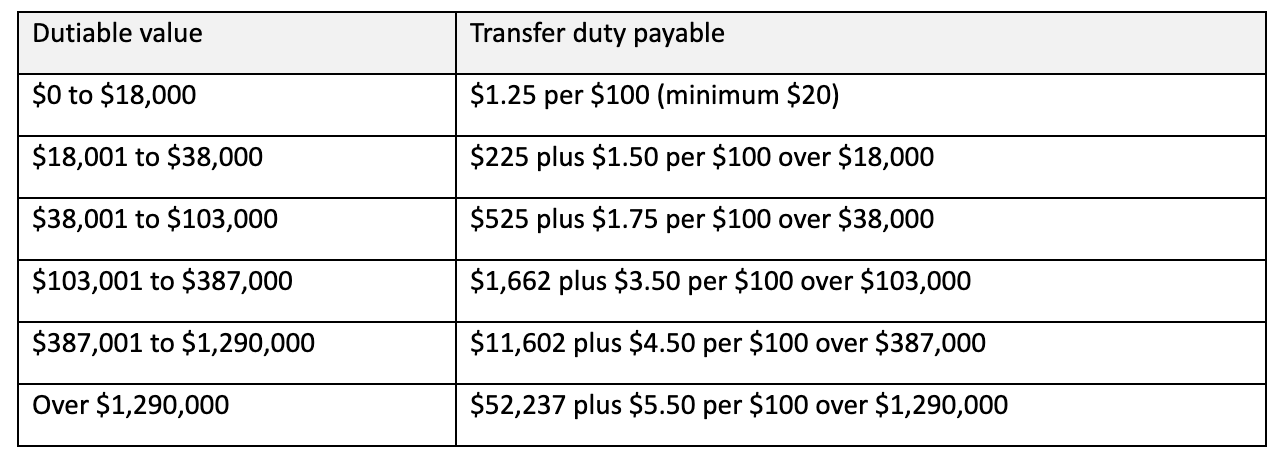
For residential land valued over $3,870,000, premium duty applies instead: $194,137 plus $7.00 per $100 over $3,870,000.
These general rates are the same whether you are buying a home to live in or an investment property. Unlike some other states, NSW has no general owner-occupier discount. Source: Revenue NSW — How to calculate transfer duty.
A worked example
A couple are upgrading from their first home to a $950,000 established house. Neither is eligible for a concession, so general rates apply.
The price sits in the $387,001 to $1,290,000 bracket:
Base amount for the bracket: $11,602
Plus $4.50 per $100 on the amount over $387,000: $563,000 × 4.5% = $25,335
Total transfer duty: $36,937
That is an effective rate of about 3.9% of the purchase price. A common mistake is to apply the top marginal rate to the whole price, which here would give $42,750 — an overestimate of almost $6,000. Underestimating is just as easy, particularly if you are working from last year's thresholds.
Now compare an eligible first home buyer purchasing a $750,000 home. Under general rates, the duty would be $27,937. Under the First Home Buyers Assistance Scheme, it is nil.
First home buyer concessions
The First Home Buyers Assistance Scheme can remove or reduce duty for eligible purchasers. Unlike the general rates, these thresholds are not indexed each year.

Above the upper threshold, full duty applies. Eligibility is assessed strictly. In summary, purchasers must generally:
be individuals aged 18 or over, with at least one purchaser an Australian citizen or permanent resident;
not have previously owned residential property in Australia, and not have a spouse or partner who has;
not have previously received a first home buyer duty concession or the First Home Owner Grant; and
move into the home within 12 months of completion and live there continuously for at least six months.
The residence requirement matters. If it is not met, the concession can be reversed and the full duty reassessed, with interest. The $10,000 First Home Owner Grant is a separate payment, available only for new homes, with its own caps and conditions.
Situations that need closer attention
The standard calculation covers an ordinary sale between strangers. Several common situations fall outside it, and each turns on legal detail rather than arithmetic.
Transfers between family members. Selling or gifting property to a child, sibling or parent below market value does not reduce the duty. Revenue NSW assesses duty on market value, and may require a valuation.
Transfers between spouses and on separation. A transfer of the principal place of residence between spouses or de facto partners may be exempt where the conditions are met. Transfers made under family law orders or a binding financial agreement following a relationship breakdown are also generally exempt. The documentation must be correct for the exemption to apply.
Deceased estates. Transfers from an estate to beneficiaries can attract different treatment to an ordinary sale, depending on how the transfer is made.
Foreign purchasers. A foreign person acquiring residential-related land in NSW generally pays surcharge purchaser duty of 9% of the dutiable value, on top of transfer duty. A foreign co-purchaser can trigger the surcharge on their share even where the other purchaser is an Australian citizen.
Companies and trusts. Buying through an entity, or acquiring an interest in a landholding entity, involves separate rules and should always be reviewed before you commit.
Four mistakes worth avoiding
Budgeting from out-of-date figures. Thresholds change every 1 July. A calculation saved last financial year is already wrong.
Applying a flat percentage. Duty is tiered. A single rate across the whole price will misstate the figure, sometimes by thousands.
Assuming you qualify for a concession. First home buyer eligibility depends on ownership history, residency and occupation. Confirm it before exchange, not at settlement.
Leaving duty out of your settlement funds. Duty sits on top of your deposit. Whether it can be funded through your loan depends on your lender, so confirm this early.
How Evans & Wislang can help
Our property law and conveyancing team reviews your contract before you exchange, calculates the duty payable on your purchase, and confirms whether any exemption or concession applies to you. Where a transaction involves family members, a separation, an estate or an entity, we advise on the duty consequences as part of the transaction itself.
If you are preparing to buy, speak with our team before you sign.
Frequently asked questions
Is transfer duty the same as stamp duty? Yes. “Stamp duty” is the older name. The current legal term in NSW is transfer duty.
Do investors pay more than owner-occupiers? Not under the general rates. Both pay on the same scale. Foreign purchasers pay an additional surcharge.
Can I pay transfer duty after settlement? No. Settlement cannot proceed until duty has been paid, even though the formal deadline is three months from the contract date.
What happens if I claim the first home buyer exemption and then rent the property out? If you do not meet the occupation requirement, Revenue NSW can reverse the concession and reassess the full duty, plus interest.
This article provides general information only and does not constitute legal advice. Rates and thresholds are current for the 2026–27 financial year and are subject to change. For advice on your circumstances, contact Evans & Wislang Solicitors.